Continuous Recording Vs Motion Detection Cctv Uk
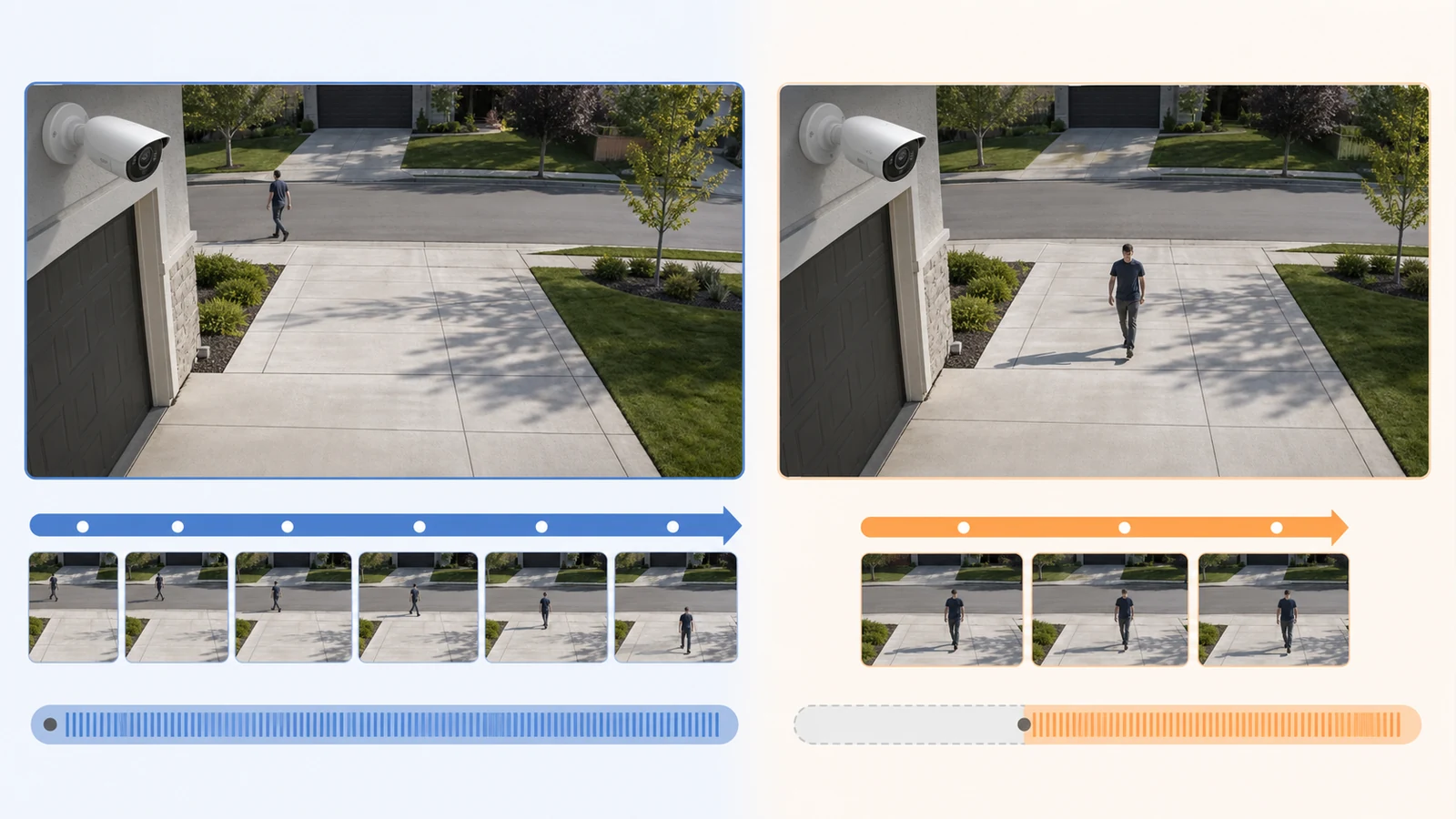
Direct answer: continuous CCTV recording keeps the whole timeline, while motion detection keeps selected clips. Motion-only can save storage and make review faster, but it can also miss the seconds before a person, vehicle or package dispute becomes visible.
UK CCTV explainers such as CCTV.co.uk's recording guide separate continuous 24/7 recording from motion detection because they solve different problems. The practical question is not which sounds more modern. It is which evidence you need in each zone.
Decision Table
| Zone | Better default | Why |
|---|---|---|
| Front door and package drop | Continuous or continuous with motion bookmarks | You often need the approach, the handover and the departure, not only the moment at the mat. |
| Driveway | Continuous at night or during known risk periods | Headlights, shadows and partial movement can make motion-only tuning awkward. |
| Detached garage or tool store | Continuous when tools or bikes are stored there | A quiet area has fewer clips, but one missed lead-in can remove the useful route evidence. |
| Quiet rear garden | Motion bookmarks can be enough after testing | Lower traffic may make motion review manageable if zones are tuned carefully. |
What Continuous Recording Gives You
Continuous recording is strongest when the argument is about timing. Who arrived first? Did a parcel sit outside for two hours? Did someone approach from the side path before appearing at the door? CCTV42's recording-mode guidance warns that motion-only recording can create gaps that weaken disputes; see CCTV42 on recording modes.
The trade-off is storage. Camera count, resolution, frame rate, compression and drive size all change retention. Do not accept a fixed number of days unless it is stated for the exact configuration you are buying. For this article, no specific Hiseeu hard-drive capacity or retention period is claimed.
What Motion Detection Gives You
Motion detection is useful as a filter. It can mark busy parts of a continuous timeline, reduce review time, and lower storage pressure when configured as motion-only. It is weaker where detection starts late, glare causes false triggers, or the important action begins outside the zone.
If your main worry is internet loss, separate that from recording mode. Some local recorder systems can keep recording without internet while internet is mainly for remote viewing and alerts, a point discussed in Networking2000's UK home CCTV guide. For more detail, read what happens when broadband drops.
Negative Fit
Do not rely on motion-only as your main evidence layer if you have already lost the start of a delivery, driveway or garage event. Do not choose continuous recording without checking storage either. The sensible middle ground is often continuous recording on the high-risk approaches, with motion bookmarks to make review practical.
Conditional Next Step
If your decision table points to continuous local recording across several cameras, then it is reasonable to review a local NVR kit only if continuous recording is a priority. If you only need one portable indoor camera, a simpler motion-clip device may fit better.
Sources
- CCTV.co.uk - UK CCTV explainer contrasts continuous 24/7 recording with motion detection, noting continuous keeps unbroken timelines while motion saves storage but can miss events if poorly set.
- CCTV42 - UK retailer guidance prefers continuous recording for evidence completeness and warns motion-only systems can miss deliveries or create gaps that undermine disputes.
- Networking2000 - 2026 UK home CCTV buyer guide notes many local recorder systems can keep recording without internet, while internet mainly enables remote viewing and alerts.